
The ACCA ATX roadmap: Everything you need to know to pass first time

The ACCA advanced taxation exam (ATX for short) is widely regarded as one of ACCA’s most rewarding yet demanding optional papers.
Whether you’ve already cruised through your applied skills exams or you’re trying to figure out which strategic professional options are right for your career, trust us, you need to understand exactly what this paper entails.
With its massive syllabus and the inclusion of complex, multi-tax planning scenarios, ATX represents a significant step up from the calculation-heavy tax exams you’ve sat before. But with the right strategy, it is also highly passable.
Doing a bit of reading now and ensuring you know how to prepare for the ACCA ATX exam is one of the most valuable uses of your study time.
Read on to find out more about what this exam looks like and exactly what you need to do to pass!
What is ACCA ATX & how does it compare to TX?
ACCA ATX is one of the four “options” papers at the strategic professional tier, the final stretch of your journey to becoming a fully qualified chartered accountant.
While some papers are compulsory (SBR and SBL), you get to choose two options. If you see yourself working in practice, advising business owners, or managing corporate tax strategies, ATX is a phenomenally valuable paper to have on your CV.
The ACCA ATX exam is designed to test your ability to act as a professional tax advisor.
This means you aren’t just looking at numbers on a page – you are evaluating real-world business decisions. You might be playing the role of a senior tax consultant advising a client on how to pass down their family business to their children with minimal inheritance tax, or helping a corporate client structure a cross-border acquisition.
At the lower applied skills level (TX), you focused primarily on single-tax computations. In contrast, ATX requires you to look at the “big picture” and advise on how multiple taxes interact.
Here is a quick summary of how the advanced taxation exam compares to your intermediate tax paper to help you understand what actually changes:
FREE Mock Exam & Debrief Video
 |
| Access our free ACCA ATX mock exam and debrief video when you create your free Astranti account! |
Inside the ATX exam: Format, marks & on-screen tax table
FREE Mock Exam & Debrief Video
|
| Access our free ACCA ATX mock exam and debrief video when you create your free Astranti account! |
Inside the ATX exam: Format, marks & on-screen tax table
When you step into the computer-based exam (CBE) arena, you will face a 3-hour and 15-minute exam split into two compulsory sections.
The marking structure is very specific:
Section A (50 marks):
Consists of one compulsory 50-mark case study. This is broken down into 40 technical marks (including 5 marks for ethics) and 10 professional skills marks.
Section B (50 marks):
Consists of two compulsory 25-mark questions. Each question is broken down into 20 technical marks and 5 professional skills marks.
In addition to technical points, ATX awards 20 professional marks. The examiners will grade you on four specific skills:
Communication
Presenting clear, logical reports or memos with a professional tone.
Analysis and evaluation
Applying underlying tax rules to calculate and evaluate different options for a client.
Commercial acumen
Using the context of the scenario to recommend realistic and practical tax solutions.
Scepticism
Carefully challenging opinions or assumptions expressed by individuals in the scenario.
Do I need to memorise tax rates?
Let’s face it: UK tax legislation is massive, and it changes every single year.
The professional bodies know this, and in the real world, no one expects you to memorise every single tax band, threshold, and relief percentage off by heart.
During your exam, you will have access to a digital, clickable ACCA ATX tax table directly on your screen.
This is a lifesaver because it contains standard rates for income tax, capital gains tax, inheritance tax, corporation tax, and VAT.
With this safety net in place, the exam is not a memory test. Instead of rewarding you for remembering a rate, the examiner rewards you for knowing how and when to apply that rate to solve a client’s problem.
You do, however, need to be fully comfortable with how to navigate the digital exam workspace, split your screen, and reference these tables quickly without eating into your precious writing time.
Why do students struggle with ATX?
While having the tax tables available on-screen is a great comfort, don’t let your guard down!
ATX is a rigorous paper that brings a unique set of challenges:

Severe time pressure
With a massive, detailed client case study in Section A, time management is your greatest obstacle. Spending too much time fine-tuning a calculation can leave you with no time to write the vital advisory explanation that actually secures the pass.
The tax update cycle
Because tax rules change annually, you must make absolutely sure your study texts and exam kits match the correct Finance Act for your exam sitting. (For example, exams from June 2026 to March 2027 test the Finance Act 2025). Studying with outdated material will cause you to drop critical marks.
Drafting your answers
Many students struggle with the transition from the math-focused skills taxation (TX) paper to the written, advisory nature of ATX. You have to learn how to explain complicated technical rules in simple, non-jargon language that a real client can understand.
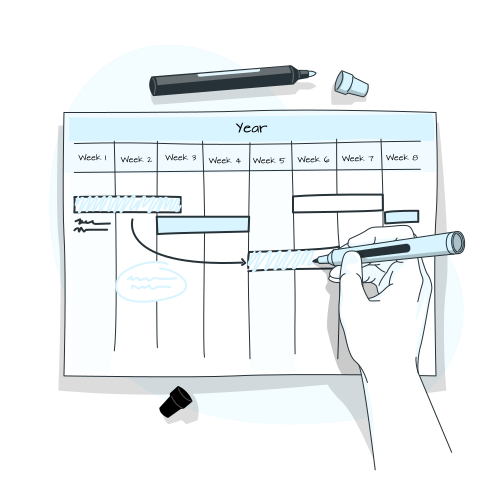
The 12-week strategic roadmap to a first-time pass
To help you stay on track, we have broken down your path to a first-time pass into four distinct milestones – navigating this journey requires steady progress rather than cramming at the very end.
The transition (weeks 1-3)
Before diving into advanced areas, use your first few weeks to refresh your knowledge of applied skills (TX). You cannot design complex group corporate relief strategies if you can’t calculate a basic corporation tax liability!
The core syllabus (weeks 4-8)
This is where you build your technical muscle. Focus on the high-value areas that regularly anchor the exam, namely corporate group structures, inheritance tax (IHT), trusts, and personal wealth planning.
Advisory drafting (weeks 9-10)
During this phase, stop focusing purely on the math and start focusing on your phrasing. Practice taking complex technical tax implications and translating them into simple, clear memos for lay clients.
The final practice run (weeks 11-12)
Dedicate your final two weeks entirely to mock exams under strictly timed conditions. Get the essential exam practice you need here.
Your ATX support FAQs
What is the pass rate for ATX ACCA?
The global pass rate for ATX ACCA typically ranges between 47% and 53%. The most recent sitting was at 47% in June 2026.

What is the format and structure of the ACCA ATX exam?
The ATX exam is a 3-hour 15-minute computer-based exam (CBE) worth 100 marks split into two compulsory sections. Section A features one 50-mark comprehensive case study (including 10 professional skills marks), while Section B consists of two 25-mark scenario-based questions (with 5 professional skills marks each).
Do I need to refresh my TX (Taxation) knowledge before starting ATX?
Yes, ATX builds directly on the core foundation established in TX (Income Tax, Corporation Tax, CGT, IHT, and VAT). If you took TX a while ago or received an exemption, spending a week or two reviewing foundational TX concepts is essential before tackling advanced ATX topics.

How does ATX differ from the TX (Taxation) exam?
While TX focuses on basic tax computations and single-tax rules, ATX requires strategic tax planning and commercial advisory skills. You are assessed on your ability to evaluate multi-tax scenarios – such as balancing Income Tax, Capital Gains Tax, and Inheritance Tax simultaneously – to provide holistic, client-focused recommendations.
What is the 7-year rule for ACCA?
The 7-year rule applies specifically to the strategic professional tier. Once you pass your very first strategic professional exam, a rolling 7-year clock starts.
You must pass all of your remaining professional exams within this window, or your oldest professional passes will expire, and you will be required to sit them again.
Which ATX variant should I choose?
The UK variant (ATX-UK) is the most popular globally and supported by nearly all major tuition providers. However, if you intend to practice accounting in a specific country with its own variant (such as Malaysia, Singapore, or Ireland), you should choose that specific local tax variant to align with your career goals.
Free ACCA ATX Resources
Unlock a full practice assessment and an accompanying expert walkthrough video at no cost. These tools are specifically tailored to sharpen your technique for the ACCA ATX exam while providing professional insights into the marking process.
Explore the various ways Astranti supports your journey toward ATX success…
Comments
Illustration by Storyset.